


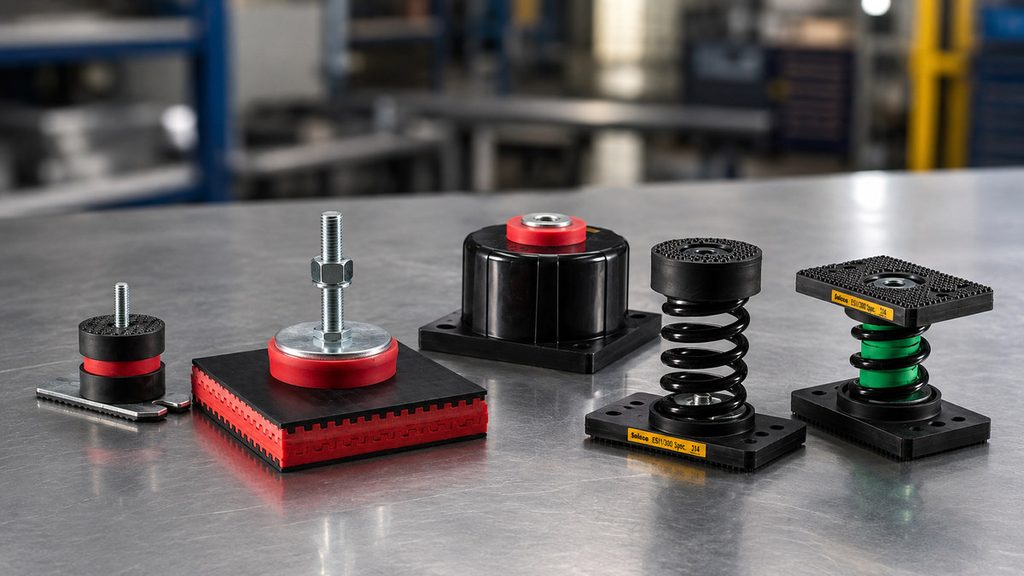
Springs and elastomers meet different requirements. Choosing the right vibration isolator means looking at how the machine operates, the vibrations to be isolated and the installation conditions.
Start with the frequencies
Every machine generates vibrations at specific frequencies. The machine and its isolator form a system with a natural frequency. If this approaches the excitation frequency, resonance may occur, potentially increasing the vibrations transmitted to the supporting structure.
Effective isolation therefore depends on sizing the isolator to suit the frequencies involved, as well as the loads and the configuration of the system.
When to consider a spring
A spring allows greater deflection under load and can achieve lower natural frequencies. It is particularly suitable when low-frequency vibrations need to be isolated or a high level of vibration isolation is required.
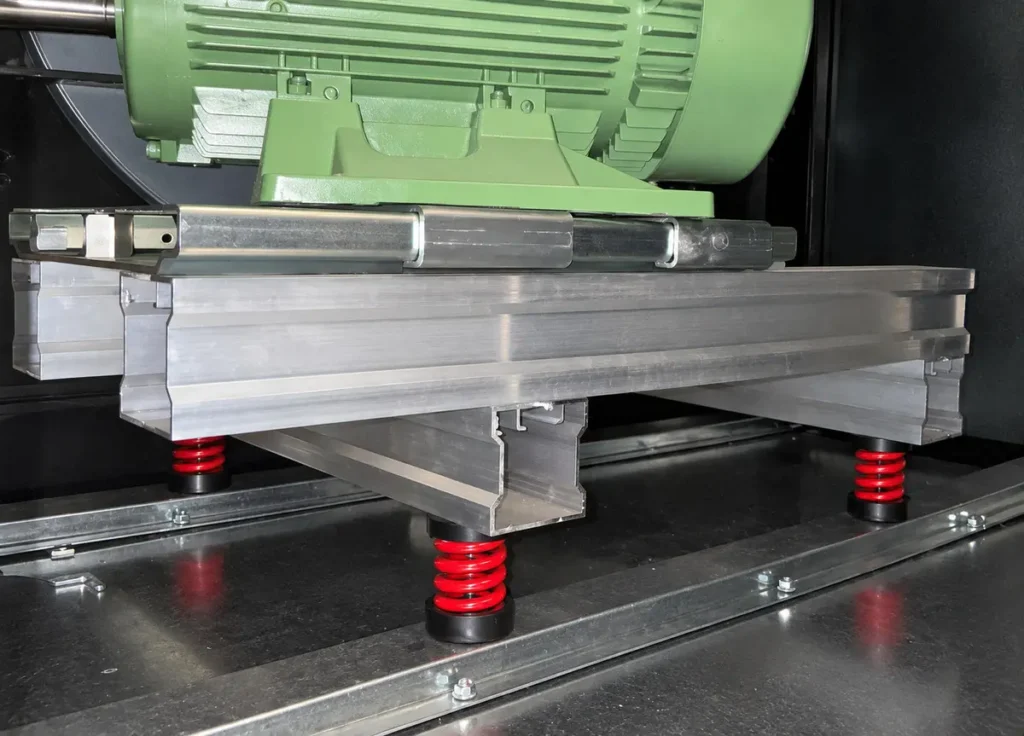
Soleco single spring mounts are available in different configurations and load capacities. The range includes harmonic steel springs protected by cataphoretic treatment and, in many versions, plates coated with thermoplastic elastomer. These help improve the mount’s stability and reduce noise transmission.
Typical applications include fans, pumps, generators and small outdoor units.
When to consider an elastomer
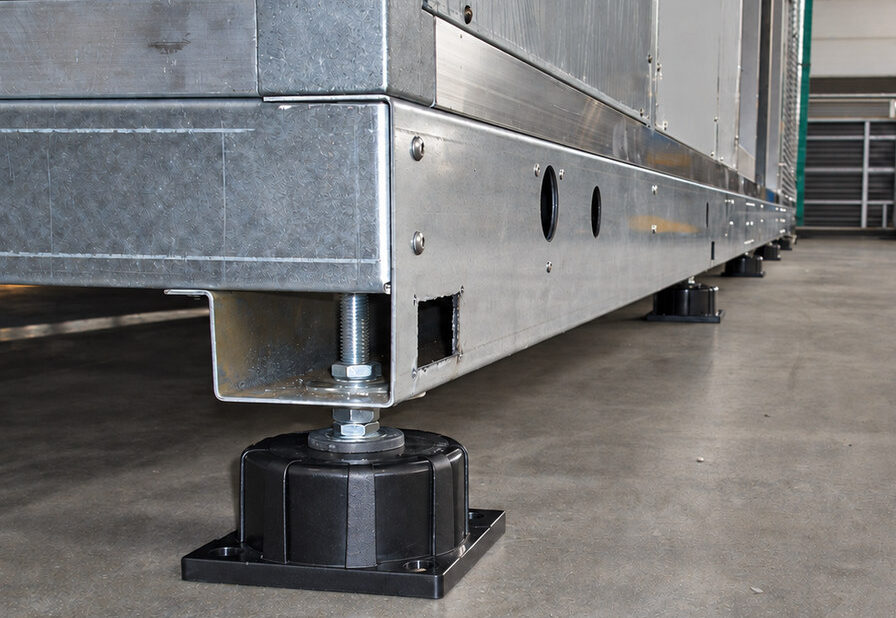
In elastomeric dampers, the same material provides both elasticity and energy dissipation. Compared with a spring, elastomer has greater inherent damping and is particularly suitable for isolating higher-frequency vibrations.
Soleco elastomeric dampers are available in different shapes and hardnesses, selected according to the load and application. The thermoplastic elastomers used in the range also offer resistance to ageing, UV rays, hydrocarbons, salt spray and detergents.
The right choice depends on the whole system
In short:
- Spring: greater deflection and a lower natural frequency
- Elastomer: compact design and greater inherent damping
The machine’s total weight is only one part of the picture. Correct sizing also takes into account:
- how the load is distributed across the support points
- the operating frequency
- the number and layout of the isolators
- the temperature and environmental conditions
Correct sizing helps reduce vibrations and the forces transmitted to the structure, contributing to the reliability of the installation and the comfort of the surrounding environment.